
The short answer
Across a large pool of studies, readers understood factual text better on paper than on screen, and that gap widened when they were working against the clock. It is not a reason to ban screens from a child's reading altogether, but it is a reason to think twice about testing comprehension of a dense document on a device, under time pressure.
What the evidence says
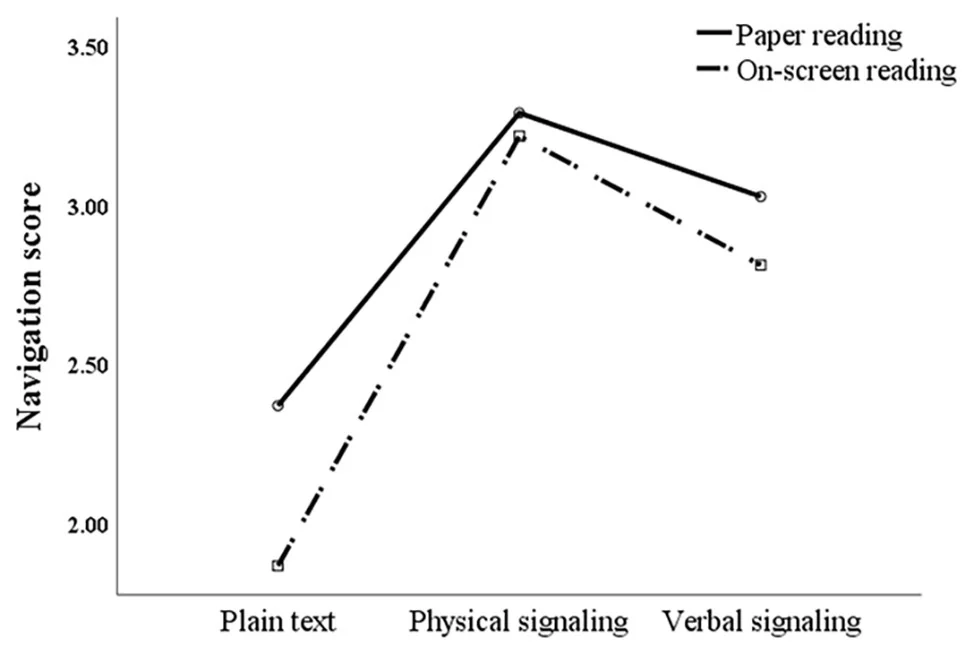
Pablo Delgado, Cristina Vargas, Rakefet Ackerman and Ladislao Salmerón combined 54 studies covering more than 171,000 participants in a meta-analysis published in Educational Research Review in November 2018, with the journal record placing it in volume 25, pages 23 to 38. Meta-analysis pools the statistical results of many separate studies rather than running a new experiment, which lets researchers ask whether a pattern holds across different samples, materials and countries rather than trusting any single result. The authors identified three factors that changed the size of the paper advantage: whether readers worked under a time limit or at their own pace, whether the text was informational or narrative, and the year the underlying study was run. The advantage for paper grew larger specifically in time-constrained reading compared with self-paced reading, and it was more consistent for informational, fact-dense text than for stories.
For context
A meta-analysis is only as good as the studies feeding into it, and reading research spans many different screens, formats and age groups that a single average obscures. The comprehension measured here is largely factual recall and understanding of expository passages under laboratory-style conditions, not every kind of reading a child does, and it says nothing about reading enjoyment, motivation or the value of audiobooks or interactive ebooks for younger readers. The finding that publication year was itself a moderator is worth sitting with: as screens and reading interfaces have changed, so has the size of the gap, which suggests this is not a fixed law of the human eye but a pattern that depends partly on the technology of the moment.
A practical next step
For homework or revision that involves dense factual material and a deadline, you could try printing the material rather than assuming a screen will work just as well, and see whether that changes how a child performs on a subsequent quiz.
- Is this reading task time-pressured, like a test, or open-ended, like leisure reading?
- Is the material factual and dense, or more like a story that holds attention on its own?
- Would switching a specific homework task to paper make a noticeable difference for this child?
The honest summary is narrower than paper being simply better: under time pressure, with informational text, paper carried a real and repeated advantage across a large combined sample, and that specific combination is where the evidence is strongest.
Sources & reading trail
Journal record and abstract confirm the meta-analysis of 54 studies and over 171,000 participants, and the time-pressure and text-type moderators.
Source published: 1 November 2018 · Retrieved: 16 September 2026
Publisher record confirms journal placement, volume and page numbers for the meta-analysis.
Source published: 1 November 2018 · Retrieved: 16 September 2026
Studies and official documents establish the record; the short answer and the next step are Screens & Childhood editorial interpretation. This retrospective draft does not imply the site published on the event date.