
The short answer
A 2017 survey of parents found that toddlers who used touchscreens more also slept somewhat less at night, with a little of that time reappearing as daytime napping. The overall pattern was a small net loss of sleep for every extra hour of daily use. This is a snapshot from one point in time, not proof that device use caused the shorter nights, so there is no need to treat a bit of tablet time as a sleep emergency.
What the evidence says
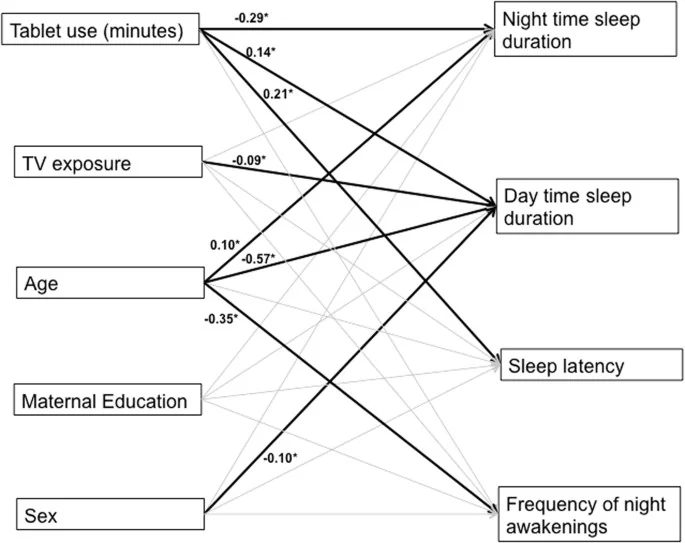
The study, published in Scientific Reports on 13 April 2017, surveyed 715 parents of children aged 6 to 36 months in the United Kingdom. Parents reported how long their child typically used a touchscreen device each day, on average about 24 minutes, and answered standard questions about their child's sleep. After adjusting for the child's age, sex, television viewing and the mother's education, the researchers found that each additional hour of touchscreen use was associated with 26.4 fewer minutes of night-time sleep and 10.8 more minutes of daytime sleep, for a net loss of about 15.6 minutes of sleep overall. Longer touchscreen use was also associated with it taking longer for children to fall asleep. There was no association with how often children woke during the night.
For context
The design here is cross-sectional: everyone was surveyed once, so the study cannot say whether more screen use led to less sleep, whether more wakeful toddlers were given more screen time to settle them, or whether some third factor, such as a household's evening routine, shaped both. The authors themselves describe this as the first report linking touchscreen use with sleep problems in this age group and call for longitudinal work to test the direction and any biological mechanism, such as light exposure close to bedtime. The measure of use was also a single parent-estimated figure with no detail on what was watched, when, or where, so a bedtime video call and an after-dinner game are folded into the same number.
A practical next step
If sleep is a struggle in your house, you might treat the timing of screen use, rather than the total minutes, as the first thing to look at, since delayed sleep onset was one of the clearer associations here. Moving touchscreen use earlier in the evening is one option worth trying alongside, not instead of, an existing bedtime routine.
- Roughly how much of our child's screen time happens in the hour before bed?
- Has sleep changed recently, and did screen habits change around the same time?
- What does our child's routine look like in the thirty minutes before lights out?
A correlation of this size, drawn from a single parent survey, is a reasonable prompt to notice bedtime habits, not a verdict on any one family's evening.
Sources & reading trail
Reports the survey design, sample of 715 parents, and the specific associations between touchscreen use and sleep duration, onset and daytime napping.
Source published: 13 April 2017 · Retrieved: 16 September 2026
Indexes the study's abstract, confirming the sample, design and headline finding independent of the journal site.
Source published: 13 April 2017 · Retrieved: 16 September 2026
Studies and official documents establish the record; the short answer and the next step are Screens & Childhood editorial interpretation. This retrospective draft does not imply the site published on the event date.