
The short answer
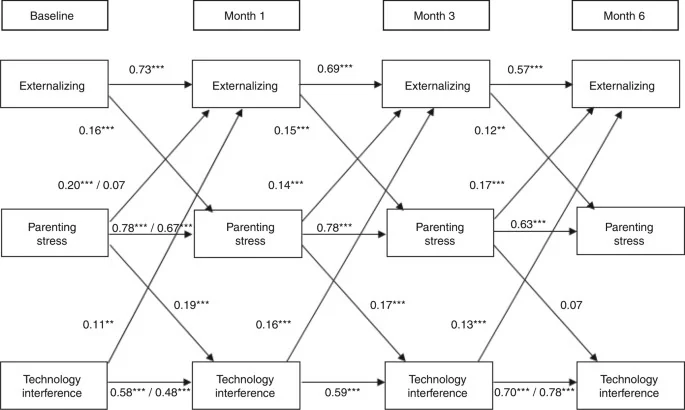
A 2018 study followed the same families over six months and found that when parents' own phone and device use interrupted time with their child, that child tended to show more difficult behaviour later, and difficult behaviour in turn predicted more parental stress and more device interruptions afterward. The traffic runs in both directions. It is a reason to pay attention to adults' habits, not a reason for any parent to feel accused.
What the evidence says
The study, published in Pediatric Research and led by Brandon McDaniel and Jenny Radesky, followed 183 couples, 337 parents in total, raising children aged one to five and a half years, with a mean age of three. Families were surveyed four times over six months: at the start, and again at one, three and six months. Parents rated how often devices interrupted their interactions with their child using a six-item Technology Device Interference Scale, alongside standard measures of child behaviour and parenting stress. Using models that track how each factor predicts the others over time, the researchers found that more reported device interference was associated with more child externalizing behaviour, such as acting out, at later assessments, with standardised associations in the region of 0.11 to 0.16. Separately, more child externalizing behaviour predicted more parenting stress, which in turn predicted more device interference later still, describing something closer to a cycle than a one-way effect.
For context
These are associations from statistical modelling of self-reported data, not an observation of any family's actual evenings, and the paper itself flags that both device interference and child behaviour were rated by the same parents, which can inflate how connected two things appear. The authors note the sample was mostly white, well-educated and cohabiting couples, so the pattern may look different in other households, and the effect sizes involved are described as small. What the design does support is a direction worth taking seriously: it treats parents' device habits as a variable in a child's development, alongside the more commonly discussed question of a child's own screen time.
A practical next step
A family media plan could name specific moments, such as pickup, mealtimes or bath time, as times when a parent's phone stays out of reach, treating it as a household habit rather than a rule aimed only at the children.
- Which parts of our day does a phone most often interrupt, ours or our child's?
- Are there one or two windows each day we could agree to keep device-free for the grown-ups too?
- When our child seeks attention while we are on a device, what do we tend to do next?
The value of this study is in redirecting the question. It does not settle what any household should do, but it makes a reasonable case that a family conversation about screens is incomplete if it only discusses the children.
Sources & reading trail
Reports the four-wave longitudinal design, the sample of 183 couples, and the bidirectional associations between parent device interference, child behaviour and parenting stress.
Source published: 13 June 2018 · Retrieved: 16 September 2026
Confirms the study design, the measures used, and the demographic limitations the authors note about the sample.
Source published: 13 June 2018 · Retrieved: 16 September 2026
Studies and official documents establish the record; the short answer and the next step are Screens & Childhood editorial interpretation. This retrospective draft does not imply the site published on the event date.