
The short answer
Roblox lets a parent set content, chat and spending limits remotely, but how much a parent can adjust, and how open a child's chat is, depends on an age band the platform assigns rather than one fixed setting. Roblox also uses an estimate of a player's age, not only the birthday entered at sign-up, to decide what chat features that player sees.
What the evidence says
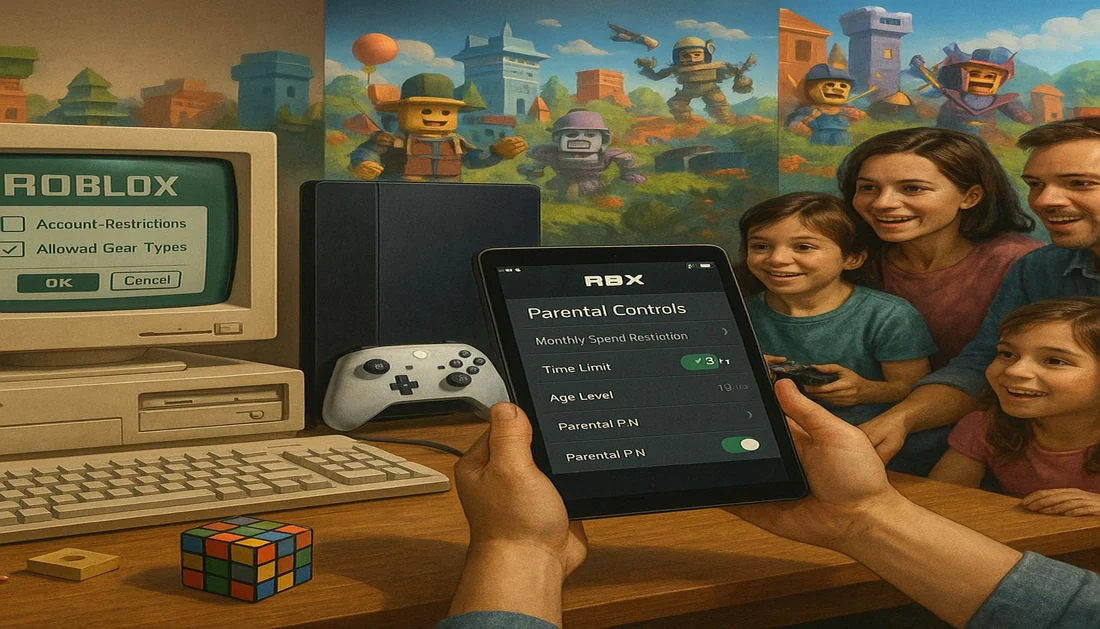
Roblox's parental controls page, current as retrieved on 16 September 2026, describes four areas a linked parent account can manage: content maturity level and game blocking, chat and connections, covering experience chat, direct chat and voice chat with friends, daily screen time limits, and monthly spending limits with notifications. The page states that in most regions a parent can manage all settings through the age of 12, while certain controls, including game management and direct chat, can be managed through the age of 15; chat with friends is available only to accounts registered as 9 or older, and voice chat with friends is switched off for all users under 13 regardless of parental settings.
A separate safety innovation page, also current as retrieved, describes age checks that place users into age-appropriate environments 'from the start' and names Facial Age Estimation as the platform's fastest such check. The same page notes that chat summaries let a user see what others in a conversation are saying even if they fall outside their age group, indicating some cross-age visibility survives the age-banding rather than being eliminated by it.
For context
An age band is an estimate applied to an account, not a verified fact about the person using it. Facial age estimation and a self-reported birthday are different mechanisms with different error patterns, and the documentation does not state how often either is overridden or contested inside a household. A control a parent can only manage through age 15 also stops being a parental lever exactly when many families most want one, which is worth knowing in advance rather than discovering later.
A practical next step
Rather than assuming the account's listed age matches your child's actual age band on the platform, you could check the parental controls dashboard directly to see which settings are currently editable, since that shows which age tier Roblox has the account in right now.
- Which parental controls on this account are still editable by you, and which have already aged out?
- Has your child's account been through an age check, such as facial age estimation, and do you know the result?
- Do you know what 'chat summaries' show your child from conversations outside their age group?
The controls are genuine and specific, but they are scoped to an age tier the platform assigns and can revise, not a setting a parent fixes once and leaves. Checking which tier an account currently sits in is a more useful habit than checking the settings menu alone.
Sources & reading trail
Living documentation describing content, chat, screen time and spending controls and the ages through which each remains parent-manageable.
Source published: Not established · Retrieved: 16 September 2026
Living documentation describing age checks, including Facial Age Estimation, and noting chat summaries can show content from outside a user's age group.
Source published: Not established · Retrieved: 16 September 2026
Studies and official documents establish the record; the short answer and the next step are Screens & Childhood editorial interpretation. This retrospective draft does not imply the site published on the event date.