
The short answer
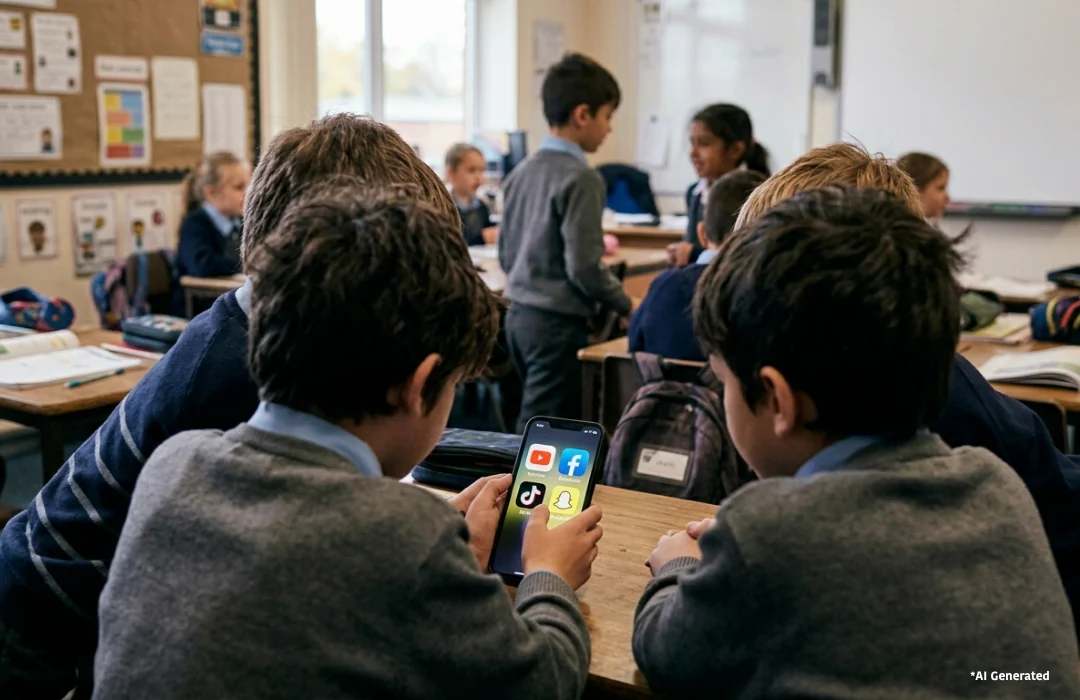
Students who said they were regularly distracted by phones or other devices in maths class scored lower in that PISA cycle. That is a real, documented association, not proof that any one child's phone caused a specific point drop, and the same report found that banning phones does not stop many students from using them anyway.
What the evidence says
PISA 2022 tested 15-year-olds' maths, reading and science, and its Results Volume II, published 5 December 2023, added a student questionnaire on wellbeing and school climate. On average across OECD countries, 30% of students reported that they get distracted using digital devices in most or every maths lesson, and 25% reported being distracted by other students' device use. The OECD's own later commentary on this data described the finding plainly: the survey linked digital distraction to lower maths performance. The report also found that formal phone bans are not a guarantee of compliance. Some 29% of students in schools that ban phone use nonetheless said they used a smartphone several times a day, illustrating that a written rule and an enforced one are not the same thing.
For context
These are self-reported associations drawn from a questionnaire completed alongside a test, not an experiment that randomly gave some classrooms devices and withheld them from others. Students who are already struggling with maths may be more likely to notice and report distraction, or more likely to reach for a phone when a lesson has lost them, which would produce the same statistical pattern without any device causing the lower score. The finding also mixes very different behaviours under one label: a phone briefly checked between exercises is not the same as a lesson spent gaming, and the questionnaire cannot fully separate them. What the data can support is a description of what many 15-year-olds notice about their own attention, not a verdict on any single family's phone policy.
A practical next step
Rather than treating a school's phone policy as settled once it exists on paper, you could ask how it is actually enforced day to day, since the gap between a rule and its enforcement is exactly what this survey measured.
- Is a phone rule in this classroom or school actively checked, or assumed to be self-enforcing?
- Does your child describe device distraction as coming from their own phone, or from classmates nearby?
- Would a specific lesson or subject benefit from a stricter device rule than the school's general policy?
The pattern is consistent enough across a large international sample to take seriously as a description of classroom life, while remaining exactly what it is: an association reported by students, not a measured cause of their scores.
Sources & reading trail
OECD report page states the 30% and 25% classroom distraction figures and the 29% smartphone-use-despite-ban figure.
Source published: 5 December 2023 · Retrieved: 16 September 2026
OECD's own later commentary describes the PISA 2022 survey as linking digital distraction to lower maths performance.
Source published: 11 February 2025 · Retrieved: 16 September 2026
Studies and official documents establish the record; the short answer and the next step are Screens & Childhood editorial interpretation. This retrospective draft does not imply the site published on the event date.