
The short answer
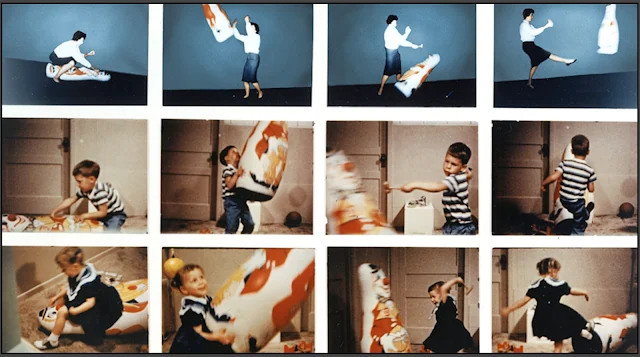
In the early 1960s, a series of experiments showed that children who watched an adult behave aggressively toward an inflatable doll would reproduce that exact behaviour later, on their own, without being asked. That demonstration became a foundation for decades of research asking whether, and under what conditions, watching aggression on screen changes how children behave.
What the evidence says
Albert Bandura, Dorothea Ross and Sheila Ross published the original design in 1961 and a filmed version two years later, in papers titled Transmission of aggression through imitation of aggressive models and Imitation of film-mediated aggressive models, both in the Journal of Abnormal and Social Psychology. A 1972 technical volume prepared for the Surgeon General's Scientific Advisory Committee, Television and Social Learning, describes the paradigm and a related 1965 study in detail: children watched a model strike a Bobo doll clown, then were placed in a room with the doll and other, non-aggressive toys. In one such demonstration, 88 percent of three- to five-year-olds reproduced novel aggressive acts they had only watched, unprompted, with some children described as virtual "carbon copies" of the model. When the model was shown being punished for the aggression, children imitated it less at first, but that difference disappeared once children were later asked directly to show everything they remembered and offered a reward for doing so.
For context
That last detail matters for what the studies show and do not show. The 1972 volume draws a distinction between a child acquiring, or learning, a behaviour by watching it, and a child accepting or performing that behaviour later on their own initiative. The reward result suggests punishment can suppress performance without erasing the underlying learning, a narrower and more specific claim than saying screen violence simply causes violence. The doll itself was inanimate, a deliberate design choice the same volume defends by comparing it to how recruits or hunters practise on inanimate targets before facing a real one; critics at the time argued this made the setting artificial, and the studies do not show that a child who imitates a scripted act on a toy will behave aggressively toward another person in an unscripted setting.
A practical next step
Rather than asking whether a violent scene will make a child aggressive, it can be more useful to ask what specific action a child is being shown, since these studies suggest specific, modelled acts are what get copied.
- Is the behaviour on screen a specific, imitable action, or a vague reference to conflict?
- Does the story show any consequence for that action, and would a child notice it?
- Has this child shown a pattern of copying specific things they have recently watched?
Six decades on, the Bobo doll studies remain a foundational, carefully bounded finding: children readily learn specific actions by watching them. What any child then does with that learning depends on consequences, context and opportunity that a laboratory doll cannot fully represent.
Sources & reading trail
Original citation details (authors, journal, volume, pages, date) for the 1961 study, confirmed via the DOI registration record.
Source published: 1 November 1961 · Retrieved: 16 September 2026
Citation details for the 1963 filmed-model replication referenced in the angle.
Source published: 1 January 1963 · Retrieved: 16 September 2026
Government-commissioned literature review describing the Bobo doll design, the 88-percent imitation finding, and the acquisition-versus-acceptance distinction.
Source published: 1 April 1972 · Retrieved: 16 September 2026
Studies and official documents establish the record; the short answer and the next step are Screens & Childhood editorial interpretation. This retrospective draft does not imply the site published on the event date.